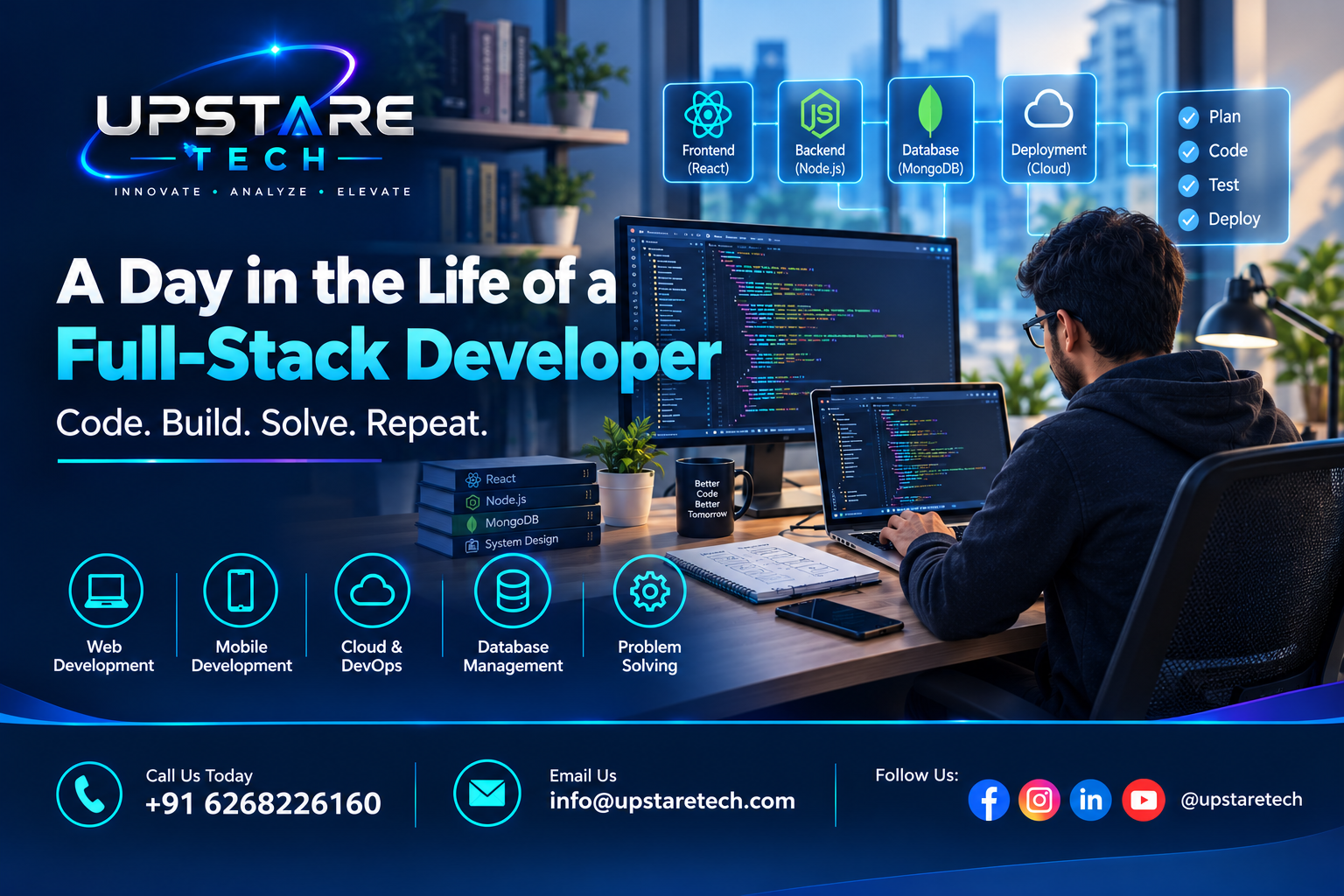
Behind the Code: A Day in the Life of a
Full-Stack Developer at Upstare Tech
Inside the Workflows, Architectures, and
Technical Strategies Shaping Modern Digital Solutions
At Upstare
Tech, software engineering is not a one-size-fits-all discipline. Our clients
range from fast-moving SaaS startups demanding real-time responsiveness to
established enterprise organizations that require content-rich platforms with
robust administrative governance. To address these diverse business models effectively,
our engineering department relies on two core developer profiles: MERN Stack
Developers and PHP Full-Stack Developers.
While both
roles share a core commitment to security, maintainability, and operational
excellence, their daily workflows, architectural philosophies, and toolsets
reflect distinct engineering paradigms. This in-depth article pulls back the
curtain on how both developer teams operate, collaborate, and make technical
decisions at Upstare Tech.
Part 1: The MERN Stack Perspective (MongoDB,
Express.js, React, Node.js)
The MERN stack
represents our modern, event-driven, single-language paradigm. By utilizing
JavaScript and TypeScript from the database layer straight through to the
browser DOM, MERN developers operate with high velocity, minimal
context-switching, and continuous reactivity.
1. Morning Routine: Stand-ups, State Management
& Event Loops
·
09:30 AM – Daily Engineering Stand-up: The
morning begins with a 15-minute sync. Today, the MERN developer reports on a
real-time analytics dashboard being built for an enterprise SaaS partner. The
goal of the day is reducing rendering overhead during high-frequency data
streams.
·
10:00 AM – React Component Engineering: The
team dives into client-side code. Using React 18, the developer constructs
component trees structured around state encapsulation and strict modularity.
Context API and Redux Toolkit are leveraged for complex application states,
ensuring performance via memoization (useMemo, useCallback) to prevent
unnecessary component re-renders.
·
11:30 AM – Non-blocking Server Architecture: Transitioning to the backend, the developer works within Node.js and
Express.js. Because Node operates on a single-threaded event loop, all I/O
operations are designed asynchronously using async/await. Schemas are defined
in Mongoose for MongoDB, enforcing validation rules while leaving flexibility
for polymorphic document structures.
|
📌 TECHNICAL ADVANTAGE: By leveraging unified TypeScript
types across both frontend and backend repositories, MERN developers
eliminate an entire class of runtime interface bugs before code ever hits
staging. |
2. Afternoon Operations: Real-time Concurrency
& API Design
·
02:00 PM – Code Review & Pair Programming: Code reviews focus on asynchronous flow safety, checking for proper
error handling in promises, prevention of memory leaks in WebSocket event
listeners, and enforcement of security headers via Helmet.js.
·
03:30 PM – WebSocket Diagnostics & Micro-optimizations: The developer addresses a scenario where WebSocket client connections
drop during spikes in concurrency. Using Socket.io heartbeat protocols and
Redis adapter pub/sub channels, state synchronization across multiple server
instances is restored without packet loss.
·
05:00 PM – Automated CI/CD Pipelines: Commits
are pushed to feature branches. GitHub Actions run automated Jest unit tests,
ESLint static analysis, and Cypress end-to-end suites before staging builds are
generated.
Part 2: The PHP Full-Stack Perspective
(Laravel, Vue/Alpine, MySQL/PostgreSQL)
PHP remains a
foundational pillar for enterprise web applications worldwide. At Upstare Tech,
our PHP full-stack developers leverage high-performance frameworks and
structured relational databases to construct highly scalable, resilient
business platforms.
1. Morning Routine: Architecture, Database
Integrity & Server Logic
·
09:30 AM – Stand-up & Architecture Review: The PHP developer coordinates with project managers to review data
modeling requirements for an e-commerce platform processing complex B2B pricing
rules.
·
10:00 AM – Business Logic & Eloquent ORM: Working primarily within Laravel, the developer builds out service
classes, repository layers, and custom middleware. Complex business operations
are wrapped inside database transactions to ensure strict ACID compliance
across MySQL or PostgreSQL storage engines.
·
11:30 AM – API & Interface Layer Integration: Depending on project requirements, the developer either wires
server-rendered views with Blade and Alpine.js or exposes RESTful resources
designed to be consumed by decoupled Vue.js components.
Part 3: The Strategic CMS Choice – WordPress
vs. Custom Interface
A critical
differentiator of Upstare Tech’s engineering model is our pragmatic approach to
backend management interfaces. We do not force every client into a standardized
framework; instead, our PHP engineering group evaluates client needs against
two main implementation strategies.
Option A: When the Client Needs WordPress as a
Backend Interface
WordPress is
far more than a blogging tool when engineered correctly. When a client requires
complex content publishing, extensive editorial permissions, multi-language
translation, and out-of-the-box SEO optimization, leveraging WordPress as an
administrative interface saves hundreds of development hours.
·
Bespoke Gutenberg Blocks: Rather than
bloated third-party page builders, our developers build native custom blocks
using React inside WordPress, granting clients full visual control within
strict brand guidelines.
·
Headless / Decoupled CMS Architectures: When
clients demand ultra-fast frontend performance, we configure WordPress purely
as a headless content API (using WPGraphQL or REST API), delivering raw content
payloads to decoupled React or Vue frontends.
·
Custom Plugin & Field Engineering: Using
Advanced Custom Fields (ACF Pro) and custom plugin code, database schemas
inside WordPress are tailored to mirror specific content models without
cluttering the admin dashboard.
Option B: When the Client Needs a Custom
Interface Built from Scratch
When a client’s
business logic requires deeply specialized data workflows, strict internal
security protocols, or custom role-based access control (RBAC) that does not
align with a standard content management system, building a custom interface
from scratch is the optimal path.
·
Bespoke Administrative Portals: Utilizing
Laravel Nova, Filament, or custom-built admin dashboards, our developers create
streamlined user interfaces tailored specifically around internal staff
workflows.
·
Granular Role & Security Control: Custom
authorization policies govern access at the field level, ensuring sensitive
operational data is only exposed to authorized personnel.
·
High-Performance Data Processing: Without
the database overhead of traditional CMS tables, custom schemas allow for heavily
indexed, high-speed queries designed for massive transactional volumes.
Part 4: Comparative Breakdown of Engineering
Paradigms
|
Engineering Dimension |
MERN Stack Paradigm |
PHP Full-Stack Paradigm |
|
Primary Use Case |
Single-Page Apps (SPAs), Real-time Dashboards, SaaS
Platforms |
Enterprise Web Apps, Content Platforms, Decoupled
Portals |
|
Backend Runtime / Logic |
Node.js (Non-blocking, Event Loop, JS/TS) |
PHP 8.x / Laravel (Multithreaded request cycle,
Strongly typed) |
|
Database Architecture |
MongoDB (NoSQL Document Store, Flexible Schemas) |
MySQL / PostgreSQL (Relational, Strict ACID
Compliance) |
|
Backend Admin Strategy |
Custom React/Tailwind Dashboard built from scratch |
WordPress CMS as Interface OR Custom Admin Portal
(Filament) |
|
Development Strength |
Unified Language Stack, Real-time WebSockets |
Rapid Data Modeling, Robust Security & Auth,
Flexible CMS options |
Conclusion: Delivering Versatility Through
Engineering Excellence
At Upstare
Tech, our strength lies in our technical breadth and objective problem-solving.
By maintaining dedicated excellence in both MERN and PHP ecosystems, we empower
our clients to choose the exact right architecture for their specific technical
and business goals.
Whether architecting
a real-time reactive application on Node and React or deploying a
enterprise-grade Laravel platform with a customized WordPress editorial
interface, our engineering teams share a single commitment: delivering
performant, secure, and scalable digital software.